About. . .

This website is meant for family historians. Readers will find information about how people and communities were impacted by natural phenomena – or Mother Nature. Blog posts will present examples of actual events and how families coped with them. Links will be added to websites and articles that may assist genealogists looking for specific data about certain areas.

Thursday, March 19, 2020

Diary: Living with a pandemic 7 (Thursday 19 March 2020)


The pandemic is still with us. You cannot turn on the TV without endless newscasts from every area about new cases, new policies, new restrictions, etc.

But there are some good things happening out there, too. Neighbours are helping neighbours – with shopping and calling or emailing to enquire about how people are doing.

Today 157 countries (up 6 in 24 hours) have reported 225,252 cases (up 20,552); 9,276 people have died (up 1,006); and 85,826 have recovered (up 2,958). Canada has 727 reported confirmed or presumptive cases (up 129).


What is happening in many communities is that people are stepping up to help. In our local newspaper, columnist Licia Corbella comments on some of the groups organizing to assist “the elderly, the immune suppressed, young mothers or anyone else who needs help.”

Caremongering has become a new word in our vocabulary. New Facebook groups were first set up to help vulnerable people in Toronto and it has turned quickly into a movement spanning not only the country but the world. As reported by the BBC news in Washington, DC, “More than 35 Facebook groups have been set up in 72 hours to serve communities in places including Ottawa, Halifax and Annapolis County in Nova Scotia, with more than 30,000 members between them. People are joining the groups to offer help to others within their communities, particularly those who are more at risk of health complications related to coronavirus. The pandemic has led to acts of kindness around the world, from delivering soup to the elderly in the UK to an exercise class held for quarantined residents on their balconies in Spain.” See more here and here and here

In Calgary we have the YYC Covid-19 Volunteers Facebook page where requests for help and offers to assist can be posted. At the time of writing this, there are over 11,000 members. See more here.

A woman in Cornwall, England, designed a #ViralKindness postcard form that she delivered around her neighbourhood aimed at those who were self-isolating. It has since gone viral with groups and individuals adopting and using it worldwide. You can print a copy of the handout here.


Grocery and drug stores are now offering special times for seniors and those with health challenges to come and shop, avoiding the large crowds.

The 8,000-member Canadian Federation of Medical Students has been doing everything from babysitting children of health-care workers to manning the phones at 811 call centres

Social media is likely to expand during these times as many of us will be hanging around the house rather than out and about.


Wednesday, March 18, 2020

Diary: Living with a pandemic 6 (Wednesday 18 March 2020)


In our home province of Alberta, Canada, the government had declared a state of public health emergency which gives sweeping powers to control gatherings of people, operations of certain businesses and spending money. These new rules are meant to slow the spread of the Covid-19 virus and protect public health in the wake of several new cases having been confirmed this week. These are in line with what other provinces and cities in Canada have done or are considering.

The decisions are being guided by the recommendations of the province’s Chief Medical Office of Health, who stated yesterday that “this is our new normal.”

Today 151 countries (up 4 in 24 hours) have reported 204,700 cases (up 16,903); 8,270 people have died (up 771); and 82,868 have recovered (up 2,020). Canada has 598 reported cases (up 157).


The recent restrictions will be on top of the closure of schools, childcare facilities and some public venues. Among the new rules are:
·         Groups of 50 or more people are banned. Existing events where such gatherings are expected are to be cancelled immediately.
·         Citizens are also banned from public places like casinos, bingo halls, theatres, children’s play centres, recreation centres and arenas, science centres, museums and art galleries, community centres, fitness facilities, and entertainment facilities like movie theatres.
·         Weddings and funerals of more than 50 people should be cancelled, as should concerts and religious gatherings.
·         Sit-down restaurants, cafés, coffee shops, food courts and other food-serving facilities, including those with a minors-allowed liquor license, are limited to 50 per cent capacity to a maximum of 50 people.
·         The ban does not apply to health care facilities, grocery stores, airports, the Alberta legislature, and other essential services.
·         Elective surgeries are being cancelled or postponed. Hospitals are gearing up for the expected rise of cases over the next few weeks.
·         Dentists are being told to restrict their treatments to emergencies only.

If we want that pizza or burger from the local pub it will have to be ordered for take-out. Mind you, that is what we have been thinking about doing anyway. For the time being we are altering our lifestyle by arranging to shop for groceries (and wine) early in the day and foregoing what had become part of our routine of eating out a few times a week.

Today we are still trying to follow our routine, although we are not out and about much. It’s still snowy and cold and here we are past the middle of March. Mother Nature is really testing us this year. At 5:00 in the morning, I am out with my dogs on their first walk. They don’t seem to mind the cold, at least for a few minutes. The streets are deserted at this time of day. We hope they don’t stay this way for an extended time.


Reading the newspaper in the morning (yes, I still have a print copy delivered) is not as much fun. And it’s not quite a big as in past days and months. The sports section did not take long to get through – it was only three pages this morning. Report headers are noticeably similar these days, too, all reflecting the Covid-19 situation.


Tuesday, March 17, 2020

Diary: Living with a pandemic 5 (Tuesday 17 March 2020)


Our country has now closed its borders to non-citizens and non-permanent residents, with a few exceptions. As well, international flights will only be permitted to land at four airports across the country where disembarking passengers will be subject to screening.

We are truly into new restrictions and regulations aimed at halting or slowing the spared of the Covid-19 virus. Every day we see new developments and, unfortunately new cases.

Today 147 countries (up 4 in 24 hours) have reported 188,297 cases (up 16,336); 7,499 people have died (up 845); and 80,848 have recovered (up 3,075). Canada has 441 reported cases (up 99).

More retailers are closing their doors. At least for the foreseeable future. They want to limit exposure of their customers but, I am sure, also their staff. It’s not surprising but it will be devastating to people who work in those establishments. There is no reasonable option, though. Before long, it could happen that only grocery stores and pharmacies may be in operation.

This is St. Patrick’s Day. But all parades have been cancelled. Many people may not know that the first parade was not in Ireland, but in a Spanish colony at St. Augustine, now part of Florida. The first such celebration was in 1601, so that is a long-standing tradition to be broken now.

Likely there will be fewer bars open to offer green beer either. I wonder if liquor stores will stay open along with those necessary grocery stores.

Children will be home from school in most areas now. My daughter-in-law offers this handy guide for non-screen activities to keep them busy if the schools do not send home lessons to pursue. Our grandchildren are now “e-learning” which means taking classes or at least having lessons sent to them via the Internet. No doubt these kinds of programs will continue to be developed after the current pandemic is over, opening many new avenues for education.


Politicians everywhere are taking it in the ear. The pundits (mostly press) are demanding answers to questions like: What are you going to do about this, or that? Why did you not do these things sooner? How do you know this plan or that plan is going to work? How come these people get to still come across our border but those can not?

These may be valid questions. As I indicated in an earlier post, though, there is no roadmap for this kind of event. But could we be in trouble by trusting those in charge who mostly have not shown themselves capable of many other aspects of governing and spending tax dollars?

Good thing we have many quality people in our health services agencies. We are going to need these professionals in Canada as we are just seeing the beginning of the major part of the outbreak here as this graph shows.


Monday, March 16, 2020

Diary: Living with a pandemic 4 (Monday 16 March 2020)


The lockdown grows...

It’s like a tsunami in slow motion. All around the world, countries are closing their borders, restricting travel and public gatherings. People away from home are being urged to return, while there are still ways to get there.

Today 143 countries (up 3 in 24 hours) have reported 171,961 cases (up 11,479); 6,654 people have died (up 591); and 77,773 have recovered (up 1,830). Canada has 342 reported cases (up 89).

Most of us will never have seen anything like this. And no one really knows where it will end. More importantly, what will be the economic fallout when it does end? While many changes to our lives resemble what might be expected in a wartime footing, no escalation of work or production of materials is taking place.

Employers are sending people home and/or laying them off. One after one, industries are slowing. Among the most affected will be the travel and hospitality businesses. For the foreseeable future, fewer people will be travelling, staying in hotels or eating in restaurants. The entertainment businesses are next in line to see fewer patrons, joining the sports venues.

There is no template for responding to this health challenge – no playbook to use in designing approaches to slow the rate of infection. No timeline for a vaccine exists. What everyone appears to agree on is that limiting contact between people will (hopefully) limit its spread.

Where we live, our provincial government announced sweeping new regulations designed to help slow or limit the spread of Covid-19. These became necessary as several new cases were determined to have spread within the community unrelated to people who have recently travelled abroad. Our city (Calgary) has declared a state of emergency and is closing all public facilities in which people gather.

The Government of Alberta lists on its official webpage concerning the Covid-19 outbreak the following policy changes and restrictions:
·         Effective immediately, student attendance at schools is prohibited. Work will continue by educators to ensure that students receive the full accreditation they need to progress to the next level or qualify for post-secondary studies.
·         In-person post-secondary classes are cancelled. Campuses will remain open.
·         All licensed child-care facilities, out-of-school care programs and preschool programs are closed indefinitely.
·         All long-term care and other continuing care facilities are advised to limit visitation to essential visitors only.
·         Places of worship are no longer exempt from restrictions on mass gatherings.
·         Any event that has more than 50 attendees and expects to have international participants, or involves critical infrastructure staff, seniors, or other high-risk populations, should also be cancelled.

Travel outside the country is being discouraged. The federal government has not yet but is considering closing our borders.

One of the most effective measures people can take is to practice good hygiene, including: “cleaning your hands regularly for at least 20 seconds, avoiding touching your face, coughing or sneezing into your elbow or sleeve, disposing of tissues appropriately, and staying home and away from others if you are sick.”

Food is still plentiful, although there are still many panic-driven shoppers who think otherwise. The water system and other utilities continue to function at their normal, high levels. Pubic transportation is not being affected although there are many who might reconsider taking a crowded bus or C-train. Once we can get rid of winter, we will at least be able to enjoy the outdoors more. So will our dogs!

Right now, education about the diseases, its effects, its symptoms and its control is paramount. All government bodies are concentrating on getting information out.


Sunday, March 15, 2020

Diary: Living with a pandemic 3 (Sunday 15 March 2020)


The pandemic situation remains fluid.

Statistics (and real numbers) are showing us that this pandemic has many of the same qualities of other epidemics. There appears to be a limited period in which cases (and deaths) increase before they level off. In China and South Korea, the numbers are leveling off after about eight weeks of rapidly escalating rates. Another month should tell us a great deal about the Covid-19 life cycle.

Today 140 countries (down 10? in 24 hours) have reported 160,482 cases (up 12,680), 6,063 people have died (up 521) and 75,943 have recovered (up 3,371). Canada has 253 reported cases (up 53). While the number is growing in Canada, it is still a very small number when you think about how big our country is. I think the cases are under-reported as there are many countries with very few, some not believable.

The rate of infections is following along similar patterns as past pandemics. China seems to have reached a plateau as the rate of new cases – and deaths – are much reduced. The situations in Italy and Iran are still of great concern.


We found grocery stores short on a few things yesterday. There is still an air of unrealistic panic among shoppers, but we are sure that will settle down in a few days. This morning most shelves were filled or being filled again, at least for milk which I picked up early.

More companies, institutions and service providers are sending out notices about what they are doing to combat or slow the spread of infections.

Everyone is getting caught up in the situation, what with meetings cancelled, travel restricted, businesses cutting back, etc. My wife had a short trip to the coast scheduled for today which we cancelled – as much because its bloody cold here this weekend. But there is a concern that you could run into someone in an airport coming back from someplace carrying the virus with them. So, yes, you could say we are in somewhat of a panic mode too. It is very early in the spreading stage to know where it is really going and how many people it will infect but it is doubtful that we will see major escalations over more than a few weeks.

Probably the biggest impact the disease is having on the world right now is on the financial side. The stock markets have collapsed. With large gatherings stopped, income from sporting events, concerts, conventions, theatres, travel, hotels, restaurants and bars and many other leisure-related activities is curtailed. Companies are sending people home and, in many cases laying them off. We could see the economic fallout for many years as governments ramp up spending (mostly through borrowing) to keep people working and fed.

The news networks are full of coverage about the pandemic, of course. Well, with no sporting events going on, what do we have to watch? Netflix will get a workout this week for sure! You can only watch bad news for so long.

Maybe I will get some of that reading done that has been stacking up. Curiously, most of it concerns famines and other nasty things that went on during the past centuries as I research a few family history-related subjects.


Saturday, March 14, 2020

Diary: Living with a pandemic 2 (Saturday 14 March 2020)


Here is my second journal entry about the pandemic. I don’t know if future posts will come daily, but the rapidly changing situation continues to offer new developments in how we go about our lives. So, I will continue to record my thoughts.

Today 150 countries (up 18 in 24 hours) have reported 147,802 cases (up 10,128), 5,542 people have died (up 462) and 72,572 have recovered (down 6,865?). Canada has 200 reported cases (up42).

According to the World Health Organization, we have never seen a pandemic involving a coronavirus. We have also never seen a pandemic that we could control, so that part is encouraging.

My wife and I are in the “vulnerable” segment of the population – both over 70. We have become aware of the danger of contracting Covid-19 as it appears to be most deadly. As of 29 February 2020, deaths of people over the age of 80 was 21.9% of those who had contracted the virus. They also represent 14.8% of all deaths from the disease. Deaths of those aged 70 to 79 were 8% of all deaths. Deaths of children with the disease are rare.

Older people more commonly will have existing ailments such as cardiovascular disease, diabetes, chronic respiratory disease, hypertension and cancer. These pre-existing conditions increase the risk of dying if infected by Covid-19 as the bodies are already weakened.

In contrast, death rates for those who contract the Spanish Flu in 1918 showed three peaks: under one year; 25 to 35 years of age; and over 70. Deaths during this outbreak were mainly from bacterial pneumonia, a common secondary infection of influenza. The high mortality for the very young and the very old was not surprising. One reason for the young adult deaths was that the stronger immune systems of young adults tended to overreact (cytokine storm), ravaging the victims’ bodies.

People our age are also vulnerable from a financial side. We are no longer in the workforce and have more limited means to recover from meltdowns of income-producing investments.

As might be expected in these types of emergencies, there have been many “feel good” stories. People, mainly younger, have stepped up to assist elderly friends and neighbours with shopping, cleaning and general assistance.

I am beginning to understand a bit about what the Psychology of Epidemics is theses days. Having had the current Covid-19 situation declared a pandemic, a whole host of actions have now been taken by governments, institutions and business around the world. One cannot ignore reports in the news as there is almost nothing but news concerning the effects of the disease and its impact on societies.

Everywhere you go you are reminded. A visit to the doctor’s office for an entirely unrelated issue leads to questions about whether you have travelled abroad recently, know someone who has done so or do you have any symptoms. That’s not a bad thing, just something we are not used to. I have received many emails from businesses, retailers, restaurants, the bank, even the veterinary clinic, to remind us that we should be careful in our social interactions, and that they are doing everything they can to keep their premises clean and sanitized. They recommend doing things online from home as much as possible.

Grocery stores are seeing runs on food. I think that may settle down once people have stocked up and realize that the supply chain here is still robust. Businesses you frequent want to reassure you they will be open to serve your needs, although their service and facilities might be run a bit differently. Everyone is indeed taking this very seriously.

Companies with large staff levels are turning their operations inside out to minimize personal contact. Where possible, employees are being encouraged to work from home. If they must interact, they should be at least at arms-length from each other. Any suggestion of illness should be met head-on with testing or self-isolation.

Public facilities like libraries, recreation centres, theatres, museums, churches, etc. are being closed. These in addition to the large arenas and concert halls. We are told to stay home unless absolutely necessary.

One thing that has not changed yet is that all the genealogy-related emails I get from people continue unabated. Many do mention, however, that the conferences or local society meetings there were going to attend have been cancelled. People and genealogical societies are rapidly shifting more to online presentations to exchange information and ideas.

The common theme you hear from every source is “We are living through very uncertain times…” No kidding!

You start to worry more about your children who live far away – particularly in Europe where the infection rates are well above of where we are in Canada. It’s bad enough being part of that older, “vulnerable” generation. The concern you always have for the well-being of your children now is compounded.

The drums keep pounding…

Friday, March 13, 2020

Diary: Living with a pandemic 1 (Friday 13 March 2020)


I read and write a lot about events related to natural phenomena, those mainly caused by Mother Nature. She has taken on a real persona to me as I relate stories about ancestors and their battles over the past centuries regarding changes to their environment and habitat.

One of the major types of events that impacted people and communities in the past is disease. I have written several blog posts and articles that concern such things as the plague, cholera, phthisis (tuberculosis), influenza and others. I know some of my ancestors died of diseases they contracted, although I have not yet documented any that succumbed during a widespread epidemic.

These past few months, the world has been plunged into what is now a pandemic. We have seen only a few pandemics in our lifetime, the latest being the global outbreak of Swine Flu in 2009 (H1N1 virus). While it was exceedingly widespread, its consequences were not as severe as some earlier pandemics.

No one is left alive who lived through the Spanish Flu pandemic that began in 1918. The death toll for that one has been estimated at between 50 and 100 million people – possibly 10% of people who had been infected. I do not know of any family members or died of the disease, but I have read accounts written by relatives whose families experienced conditions then.

What came home to us this week was that the novel coronavirus (Covid-19) has now reached into every corner of the globe and affected almost all of us who are witnessing its spread, directly and indirectly. At this time, we don’t know whether it may ultimately rival the Spanish Flu in its global extent and death rate.

Last fall I accepted an invitation to present some talks at family history conference in London. The idea was exciting and, notwithstanding the cost involved to get there, I was excited at the opportunity to be involved. My daughter was to accompany me to the event, and we planned to spend a few days in Amsterdam where my son and his family live.

At the beginning of 2020 we started to hear about Covid-19, first from China where it began. As the weeks progressed, we saw cases multiply in unbelievable numbers in China and then spread to other parts of the world where it took serious footholds. In the last couple of weeks, I have been watching it daily. It did not take long before cases were being found in the Netherlands and Britain, the two places where we planned to visit. I started to worry a bit about whether this could interrupt our trip, maybe cause us to reconsider travelling altogether.

Yesterday, the situation developed to the point that we had to decide whether to go or to stay home. All around us, events were being cancelled, travel was being discouraged, cases were increasing in number, abroad and now at home. We decided not to take any chances and forgo the trip. My son indicated he would have recommended that course of action in view of what is going on in the Netherlands.

After talking with my daughter and son, I decided I would start a journal myself about what I have seen and read, what might transpire concerning this new pandemic and how it could impact our family or other people we know. We are very hopeful we will not experience it first-hand of course.

This is the first installment. Others will be posted in my blogs as well.

In the past week, the stock market collapsed, partly due to the Covid-19 scare and the political decisions being taken, but as well by other events happening around the world. For us it has been a disaster with our holdings reduced in value by 25%. That alone was enough reason to cancel our trip to Europe.

As I write this (Friday, March 13th – 8:00 am), 132 countries now have reported 137, 674 cases. There have been 5,080 deaths (3.7%) and 79,437 people have recovered (https://en.wikipedia.org/wiki/2019%E2%80%9320_coronavirus_pandemic_by_country_and_territory). The countries most affected are China, Italy, Iran South Korea, Spain, Germany and France. We have 158 cases in Canada, an increase of 35% in the last day. One person had died. We are on the upward trajectory for infections. Even the Prime Minister’s wife has test positive, so it impacts every level of society.

Local to international health authorities have taken the leadership to provide guidance and advice to control the rate of spread of the disease. They all still expect it to grow significantly but the hope and plan is to ensure it does so slow enough to allow medical facilities to effectively treat the new cases.

All events with more than 250 people have been halted in Alberta where I live. Sports leagues from minor to professional have cancelled or paused their seasons. Entertainment and other meetings where large groups of people might attend have been cancelled. Schools are being closed in some parts of the country.

Those who think they may have symptoms of the disease, and/or may have come into contact with others that are infected are being told to self-isolate to begin with and request testing only if they develop the symptoms. People are being encouraged to practise “social distancing” and make all efforts to avoid groups and keep themselves and their surroundings clean.

The world is changing before our eyes. Be careful out there!

More to come….

Tuesday, March 10, 2020

The Psychology of Epidemics


When the conditions are right, epidemics can potentially create a medical version of the Hobbesian nightmare - the war of all against all. A major outbreak of novel, fatal epidemic disease can quickly be followed both by plagues of fear, panic, suspicion and stigma; and by mass outbreaks of moral controversy, of potential solutions and of personal conversion to the many different causes which spring up. This distinctive collective social psychology has its own epidemic form, can be activated by other crises besides those of disease and is rooted in the fundamental properties of language and human interaction. It is thus a permanent part of the human condition - and widely known to be such.”
~Philip Strong (Epidemic psychology: a model; download paper here)

In recent years we have seen the outbreak of diseases both new and old. Currently the world is watching and worried about the coronavirus. Measles, mumps, polio, ebola and, of course new strains of the flu have all taken hold is some part of the world. Some of the outbreaks are in far-flung regions, others are close to home as the hesitancy of people in seeking vaccines is putting children at risk for diseases that we thought were dead.

Along with the physical illnesses now comes the mental worry about how far these diseases can spread and whether some could become full-fledged pandemics. Fear and anxiety are manifesting themselves as an epidemic of a different kind.

Imagine how our ancestors must have felt as plague, smallpox, influenza, scarlet fever, typhus and other infections and viruses attached their communities.

Fear of epidemics can spread through a community in just the same way the disease epidemic does. It arises from fear of the unknown: what is the nature of the sickness? In the case of diseases, the fear will manifest itself much more severely if the infection has not been experienced before. Concern will be highest when no treatment is known, and outcomes cannot be predicted. People will naturally be fearful and suspicious about others who become sick and that the illness can be spread. They will be fearful that contagions may be contracted by many different means.

The fearfulness becomes an obsession in itself, even among those whose risk is very low. Even those occupying the roles of caregivers may be prone to apprehension about exposing themselves to potential infections. Results in the past have been to avoid, segregate or even persecute those who become sick or who may be thought to be carriers of a sickness. One need only think of how individual with human immunodeficiency virus or HIV.

Would people living in past centuries who came down with the plague, smallpox, cholera or influenza have been viewed much differently?

Until a disease is fully understood and its effects can be quantified, there will be disagreements in how it is transmitted and what treatment options will be the most effective. These unknowns also cause controversy and panic. In the short term, friends and family members may be isolated, the sick may lack care, unfounded ideas of who is to blame will surface and communities will be paralyzed by inaction.

The psychological effects of epidemics will be negatively impacted until normal routines can be resumed, a disease has run its course and/or effective treatment protocols are in place.

This is where we are now with respect to the Coronavirus, not unlike where societies were in the 14th to 18th centuries with the plague. We can imagine that similar deleterious mental health effects were experienced by our ancestors in the same way that we have observed going on in recent decades. Would they have impacted families more severely given they did not have the knowledge about and access to modern medical methods we now have available?
 
Scanning electron microscope image showing SARS-CoV-2 (yellow), also known as 2019-nCoV, the virus that causes COVID-19 (retrieved 9 March 2020 from https://commons.wikimedia.org/wiki/File:SARS-CoV-2_49531042877.jpg)


Disease epidemics have perhaps been among the most deadly of natural phenomena disasters. It has been estimated that the Black Death of the 14th century took up to 60% of the population of Europe before it ran its course. The Spanish Flu in 1918 infected over 25% of the world’s population (500 million people) with a death rate of 3% of those who contracted it. The Swine Flu of 2009 may possibly have infected three times as many, but the death rate was 1/10 of what resulted from the Spanish Flu.

Whether natural disasters emanate from epidemics or the psychological effects of stress it has always been clear that Mother Nature has had a significant impact on the well being of people and communities.

Tuesday, February 18, 2020

Invasions Over Frozen Seas


Occasionally Mother Nature has lent her hand to invading armies (or conspired against those being invaded, depending on your point of view). Several such events involved Swedish armies marching across a frozen Baltic Sea against northern European adversaries.

These armed conflicts were long after the Vikings used the same open seas to travel to Europe, the Middle East and out to the North Atlantic – before there was a Sweden as we know it today.

For most of the 13th to the 16th centuries, economic control in Northern Europe was wielded by a federation of cities around the southern coasts of the Baltic and North Seas known as the Hanseatic League. It began with the emergence of powerful rulers in northern Germany who expanded trade among many merchant-oriented cities in the region from Novgorod in the east to London in the west. Shipping was aided by the waters of the Baltic Sea being mostly open year-round, at least into the 1400s.
 
The spread of the Hanseatic League in 1400 (retrieved 17 February 2020 from https://commons.wikimedia.org/wiki/File:Ausbreitung_der_Hanse_um_das_Jahr_1400-Droysens_28.jpg)

Beginning in the 15th century, climate conspired to cause cold weather, drought, poor harvests and famine; plague attacked populations across Europe; the rivers and seas began to freeze over more frequently. Communication and trade were impacted by both population reduction and increasing conflict among powers outside the Hanseatic League who were facing their own economic hardships.

During the Little Ice Age, the Baltic Sea was covered in ice in most years, entirely frozen solid during a few, allowing easy passage from Scandinavia to continental Europe. One of the emerging power centres was the Swedish Empire. In search, no doubt, of lands that could produce more food and economic benefit, it expanded its reach around the Baltic, often through armed invasion. Following the end of the 30-year War (1618-48), Sweden controlled much of the region, from Russia to Denmark.
 
Map of the Swedish Empire (retrieved 17 February 2020 from https://commons.wikimedia.org/wiki/File:Sweden_1658.jpg)

Invasions of Europe by Sweden during the 16th and 17th centuries were aided by the frozen conditions of the Baltic Sea. During the Northern Wars (1655-60), Swedish troops marched right across the ice-covered Great Belt and Little Belt straits, into Denmark and Germany.
 
Depiction of Charles X Gustav looking over the ice of the Great Belt as Swedish forces march across the Belt Straits 1657-58 (retrieved 17 February 2020 from https://commons.wikimedia.org/wiki/File:T%C3%A5get_%C3%B6ver_stora_b%C3%A4lt.jpg)

The tables were turned on the Swedes in 1678. Frederick William, elector of Brandenburg and Duke of Prussia, had defeated the Swedish army at the Battle of Fehrbellin in 1675, after an attempted invasion. He further drove them from the Duchy by commandeering thousands of sleighs to transport his army across snowy terrain and frozen lakes and rivers. They were able to cut into the flanks of the Swedish forces, denying them the ability to resupply. The battle would be a precursor to a modern-day motorized infantry.
 
Frederick William the Great pursues Swedish troops across the frozen Curonian Lagoon; fresco by Wilhelm Simmler, ca. 1891; artwork was destroyed by bombing in 1944 (retrieved 17 February 2020 from https://commons.wikimedia.org/wiki/File:%C3%9Cbergang_%C3%BCber_das_Kurische_Haff_1679.jpg)

Conditions of the Little Ice Age caused deprivation and death on a widespread basis across Europe. They also resulted in many nations looking outside their boundaries for better conditions or more food sources. In some cases, trade was increased; in others, wars were fought. Frozen rivers, lakes and seas made it easier for armies to advance against their foes.

Tuesday, January 14, 2020

Blizzards – Mother Nature’s Rage


About a year ago I wrote here about Winter Weather, citing a few examples of how cold snaps and ice storms have wreaked havoc. Last November I again described the cold weather we had in Baby, it’s cold outside!

Well, here we are again in the dead of winter experiencing more frigid weather and over-the-top precipitation. I have also said before, while it may be news, this is not new. We are not expecting blizzards where I live but right now it is very cold!

As I write this is the temperature is -28℃ (1℉) outside and the dogs were very quick to do their business and get back inside the warm house. The prognosis for the next few days is not great either.
14-day forecast for Calgary, Alberta
The week was forecast to be pretty nasty for much of North America as well.

A colorful surface forecast map by the 12Z GFS for 11 January 2020 depicting a multi-hazard event with significant snow (blue) and ice (purple, pink) on the cold side of a powerful storm system and heavy rain (green, yellow) on the warm side where there will be a severe weather threat as well. Map courtesy NOAA/WPC, tropicaltidbits.com

If you have lived on the prairies for any length of time you have observed cold and storms. Central North American is famous for its blizzards, going back as far as people can remember. The Eastern coast is not unfamiliar with harsh weather, either, especially in the winter. Europe has had its share of storms

Search the internet and you will find numerous stories of great storms that pounded farms and cities, almost every decade. Becky Oskin, writing for Live Science in 2013 listed The 10 Worst Blizzards in US History. :
·         The Great Blizzard of 1888 (11, 12 March 1888) hit the Northeast, killing over 400 people
·         The Great Blizzard of 1899 (11 February 1899) struck the region from Georgia to Maine
·         The Storm of the Century (12 March 1993) caused devastation and the deaths of 310 people from Cuba to Canada
·         The White Hurricane (7 November 1913) pummeled the Great Lakes region causing 250 deaths
·         The Children’s Blizzard (13 January 1888) swept across the Dakota Territory and Nebraska where 235 people died
·         The Great Appalachian Storm (24 November 1950) killed 353 as it moved from North Carolina around to Ohio (I wrote about this one here)
·         The Knickerbocker Storm (27, 28 January 1922) when several feet of snow fell on Maryland, Virginia and Pennsylvania
·         The Armistice Day Blizzard (11 November 1940) raged over the Midwest building 20-foot snowdrifts and killing 145 people
·         The Super Bowl Blizzard (9 January 1975) was a record low pressure system that spawned tornadoes in the Southeast US as well as high winds and snow in the Midwest
·         Snowmaggeddon (February 2010) was the name given to a major blizzard that broke snowfall records in the mid-Atlantic region
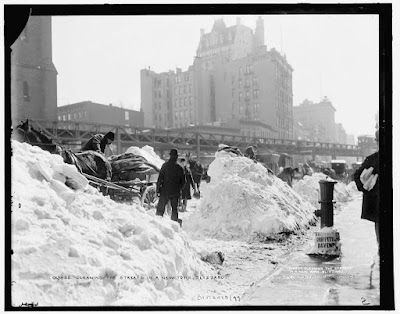
 
Cleaning up the street in New York City, February 1899
Other writers have described other major winter events. I wrote about a book that summarized many of these in a blog post last year, New England Storms. One of earliest winter storms listed struck New England on 6 February 1717, after an already cold and snowy two months. Snow drifted above tree tops, burying or causing great suffering for animals both domestic and wild, and the deaths of over 400 people.

Europe experienced the deadly Beast from the East in February 2018 as gales and blizzard conditions reached from Siberia to the Atlantic. The storm paralyzed the continent left thousands homeless.

Satellite view showing Europe, including Great Britain and Ireland partially covered in snow under the influence of the strong cold wave on 27 February 2018

Jodi Smith, writing for Ranker listed many other major winter storms in Europe and Asia:
·         Iran Blizzard (February 1972) dumped snow over 200 villages and claimed 4,000 lives
·         Carolean Death March (12 January 1719) was a forced retreat of Swedish soldiers who were caught in a raging storm in the Tydal Mountains with over 3,000 men killed.
·         Afghanistan Blizzard (February 2008) was the worst storm on record in the country when 900 people and 230,000 livestock died.
·         Hakkoda Mountains Incident (January 1902) that took a regiment of Japanese soldiers by surprise killing almost 200 of them
·         Chinese Winter Storms (January and February 2008) saw the worst storms in over 50 years, pummeling the countryside and crippling the transportation network

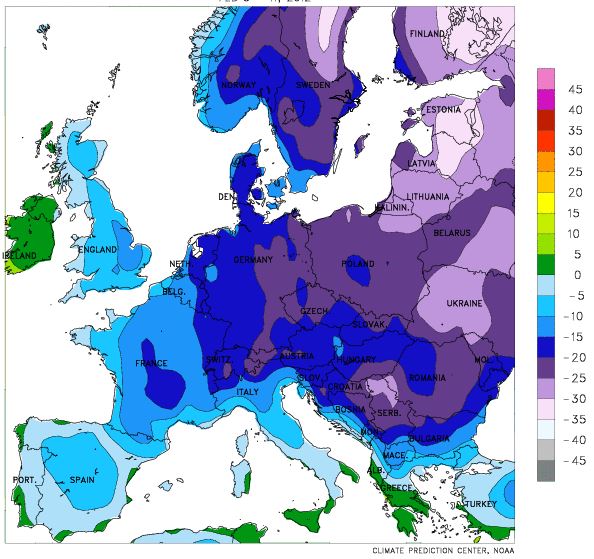
The United Kingdom witnessed a severe winter in 1894-95 when 100s of people died. Other devastatingly cold periods, many with great snowfalls, afflicted the country in 1946-47, 1962-63 (The Big Freeze), January 1987, 1990-91, 2009-10, 2010-11 and 2012. The latter affected all of Europe. And then there were the Great Frosts of 1709 and 1739-40.
 
Extreme minimum temperature February 4 - February 11, 2012 across Europe

In March of 1891, The Blizzard in the West struck Cornwall and Devon, and with snow drifts piled up tens of feet in many areas, halting all trains and communication.
 
Train sent off the track by blizzard in Cornwall, England
The list of cold winters and major blizzards is endless. Each year many of us in the North Hemisphere experience at least one big snowstorm. Reading of historical news reports demonstrates these have been common events for at least the last few hundred years.

We are much better informed and protected now that people were 100 or 200 years ago, but severe winter storms still catch and kill people and cause significant damage.