About. . .

This website is meant for family historians. Readers will find information about how people and communities were impacted by natural phenomena – or Mother Nature. Blog posts will present examples of actual events and how families coped with them. Links will be added to websites and articles that may assist genealogists looking for specific data about certain areas.

Tuesday, January 14, 2020

Blizzards – Mother Nature’s Rage


About a year ago I wrote here about Winter Weather, citing a few examples of how cold snaps and ice storms have wreaked havoc. Last November I again described the cold weather we had in Baby, it’s cold outside!

Well, here we are again in the dead of winter experiencing more frigid weather and over-the-top precipitation. I have also said before, while it may be news, this is not new. We are not expecting blizzards where I live but right now it is very cold!

As I write this is the temperature is -28℃ (1℉) outside and the dogs were very quick to do their business and get back inside the warm house. The prognosis for the next few days is not great either.
14-day forecast for Calgary, Alberta
The week was forecast to be pretty nasty for much of North America as well.

A colorful surface forecast map by the 12Z GFS for 11 January 2020 depicting a multi-hazard event with significant snow (blue) and ice (purple, pink) on the cold side of a powerful storm system and heavy rain (green, yellow) on the warm side where there will be a severe weather threat as well. Map courtesy NOAA/WPC, tropicaltidbits.com

If you have lived on the prairies for any length of time you have observed cold and storms. Central North American is famous for its blizzards, going back as far as people can remember. The Eastern coast is not unfamiliar with harsh weather, either, especially in the winter. Europe has had its share of storms

Search the internet and you will find numerous stories of great storms that pounded farms and cities, almost every decade. Becky Oskin, writing for Live Science in 2013 listed The 10 Worst Blizzards in US History. :
·         The Great Blizzard of 1888 (11, 12 March 1888) hit the Northeast, killing over 400 people
·         The Great Blizzard of 1899 (11 February 1899) struck the region from Georgia to Maine
·         The Storm of the Century (12 March 1993) caused devastation and the deaths of 310 people from Cuba to Canada
·         The White Hurricane (7 November 1913) pummeled the Great Lakes region causing 250 deaths
·         The Children’s Blizzard (13 January 1888) swept across the Dakota Territory and Nebraska where 235 people died
·         The Great Appalachian Storm (24 November 1950) killed 353 as it moved from North Carolina around to Ohio (I wrote about this one here)
·         The Knickerbocker Storm (27, 28 January 1922) when several feet of snow fell on Maryland, Virginia and Pennsylvania
·         The Armistice Day Blizzard (11 November 1940) raged over the Midwest building 20-foot snowdrifts and killing 145 people
·         The Super Bowl Blizzard (9 January 1975) was a record low pressure system that spawned tornadoes in the Southeast US as well as high winds and snow in the Midwest
·         Snowmaggeddon (February 2010) was the name given to a major blizzard that broke snowfall records in the mid-Atlantic region
 
Cleaning up the street in New York City, February 1899
Other writers have described other major winter events. I wrote about a book that summarized many of these in a blog post last year, New England Storms. One of earliest winter storms listed struck New England on 6 February 1717, after an already cold and snowy two months. Snow drifted above tree tops, burying or causing great suffering for animals both domestic and wild, and the deaths of over 400 people.

Europe experienced the deadly Beast from the East in February 2018 as gales and blizzard conditions reached from Siberia to the Atlantic. The storm paralyzed the continent left thousands homeless.

Satellite view showing Europe, including Great Britain and Ireland partially covered in snow under the influence of the strong cold wave on 27 February 2018

Jodi Smith, writing for Ranker listed many other major winter storms in Europe and Asia:
·         Iran Blizzard (February 1972) dumped snow over 200 villages and claimed 4,000 lives
·         Carolean Death March (12 January 1719) was a forced retreat of Swedish soldiers who were caught in a raging storm in the Tydal Mountains with over 3,000 men killed.
·         Afghanistan Blizzard (February 2008) was the worst storm on record in the country when 900 people and 230,000 livestock died.
·         Hakkoda Mountains Incident (January 1902) that took a regiment of Japanese soldiers by surprise killing almost 200 of them
·         Chinese Winter Storms (January and February 2008) saw the worst storms in over 50 years, pummeling the countryside and crippling the transportation network

The United Kingdom witnessed a severe winter in 1894-95 when 100s of people died. Other devastatingly cold periods, many with great snowfalls, afflicted the country in 1946-47, 1962-63 (The Big Freeze), January 1987, 1990-91, 2009-10, 2010-11 and 2012. The latter affected all of Europe. And then there were the Great Frosts of 1709 and 1739-40.
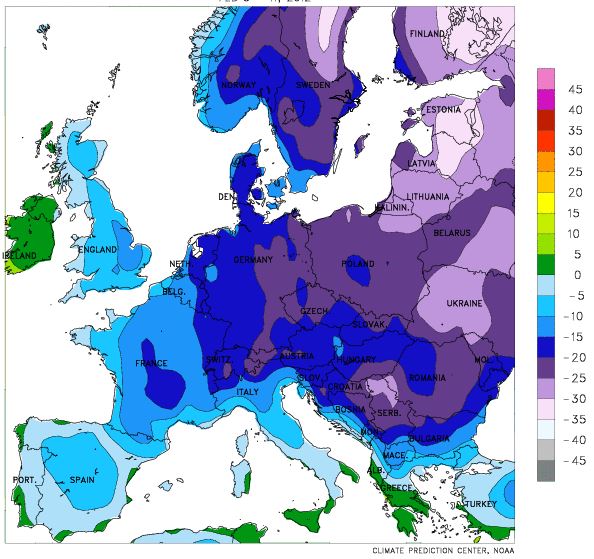
 
Extreme minimum temperature February 4 - February 11, 2012 across Europe

In March of 1891, The Blizzard in the West struck Cornwall and Devon, and with snow drifts piled up tens of feet in many areas, halting all trains and communication.
 
Train sent off the track by blizzard in Cornwall, England
The list of cold winters and major blizzards is endless. Each year many of us in the North Hemisphere experience at least one big snowstorm. Reading of historical news reports demonstrates these have been common events for at least the last few hundred years.

We are much better informed and protected now that people were 100 or 200 years ago, but severe winter storms still catch and kill people and cause significant damage.

Friday, December 20, 2019

Family Tree Live 2020 (London) Talks


I am going to London in April 2020 to attend and deliver three presentations at Family Tree Live, hosted by Family Tree magazine (UK) in partnership with the Family History Foundation. See their website for all the details.

My talks include:

·         Genealogy and the Little Ice Age: Information and perspective offered concerning studies of the families living during the prolonged harsh living conditions of the Little Ice Age (1300-1850AD), and

·         The Great Frost & Famine: The impact of the 1739-41 cold weather event on people and communities across Europe; a model for other similar events of the Little Ice Age.

I will also do a workshop about:

·         Natural Phenomena and their effects on the lives of our ancestors: Examples of how different types of natural phenomena significantly impacted lives and livelihoods in the past centuries and how people responded or adapted.

Tickets are now on sale for the event. I hope many of my readers here will be able to join me on April 17th and 18th, 2020, at historic Alexandra Palace.


Tuesday, December 10, 2019

The Effects of Sea Level Rise


Recent reports would have us believe that coastlines around the world are in danger of being flooded by extreme sea level rise – primarily from melting glaciers and polar ice caps.

But what is the true history of sea level rise? And how did humans cope with it in the past centuries?

The greatest rises in sea level have come at the end of major ice ages during the last few million or so years. Technically, we are presently in what is known as an interglacial period, this one called the Holocene. Major ice ages over the last several million years appear to occur about every 40 to 100 thousand years. The Holocene is about 10,000 years old.


Most of the “recent” (1,000s of years) rise in sea level occurred as the ice sheets of the Wisconsin Glacial Episode were melting, beginning around 20,000 years BP (before the present). Melting “rapidly” (in terms of geologic time) picked up speed around 14,000 years BHP. Most of the ice was gone, and sea level was close to its maximum position about 7,000 years BP. Since then there have been minor adjustments up and down as climate alternately cooled and warmed.


Geological data show that the total rise in sea level during the last 20,000 years has been about 425 feet (130 metres). During the last 7,000 years it has come up only about 20 feet.

Interestingly, the Greenland ice sheet has been estimated to be melting in recent years at about 67 cubic miles (280 cubic kilometres) per year. That sounds like an enormous quantity but given its current volume of 684,000 cubic miles (2.85 million cubic kilometres), it would take over 10,000 years to completely melt. Looking at the last million years of history, the Earth would be well into another major ice age long before then making it highly unlikely the Greenland Ice Cap could ever be gone. Ditto for the Antarctic ice polar cap.

The amount of water contained within the Greenland Ice Cap, if it entirely melted at current rates, would add about 0.2 mm to sea level.

So, what does melting-glaciers and ice caps have to do with genealogy? Well, most of what we look for in terms of family history records was produced during the Little Ice Age (1300 to 1850 AD). During that cold period glaciers advanced and ice packs extended from the polar regions. At its maximum state, sea level dropped about four feet.

A drop of a few feet was not enough to disrupt habitation on a major scale, but in many regions along the sea coasts, it was enough to expose shallow marine shelves. These areas were covered by fine-grained material, eroded from the continents and carried to the oceans. They were also unconsolidated and subject to easy relatively removal during storms and high winds. The results were buildups of coastal dunes and beaches, and in some cases burial of farms and villages. Port areas were also affected as water levels dropped with wharves then having to be built out further seaward.

Family historians may find that coastal communities where their ancestors lived were altered by wind-blown sand covering their fields. Examples include the Culbin Forest, Morayshire, along the northern coast of Scotland, where sands covered the farmland in the late 17th century. The Forvie area of Aberdeenshire experienced burial by sand dunes over several thousand years but the greatest impact was during the 15th and 16th centuries – the Little Ice Age period.

Major storms and wave action provided the energy and means to erode shorelines. Such has been the case along much of the eastern and southern coasts of England. Dunwich in Suffolk, England, is a prime example of where the coastline has been eroded back over one half-mile since the 14th century, completely eradicating the ancient town.

Sea level rise does not fall into the category of disasters, but gradual changes over decades would have affected lives and livelihoods, even causing people to move. This happened more than a few times before the Little Ice Age – with seas rising during warm climatic periods and falling during the cold ones. Just changes of a few feet affected many coastal areas of Europe.

Some communities, notably the Dutch, found ways of mitigating against the changes in sea level by the construction of dikes. In addition, because they were hemmed in by other groups and could not expand their agricultural base, they learned to convert the swampy areas to productive farmland by pumping out the excess water.

Humans always adapt to Mother Nature’s whims. We are in no danger of seeing major changes in sea level in the future, though, not even the few feet observed during the rise during the Medieval Warm Period (900 to 1300 AD) or the drop during the Little Ice Age. But changes will continue to occur naturally along all coastlines around the world.

Thursday, November 21, 2019

My Latest Published Articles

I have two new articles published concerning Mother Nature's Tests and family history.

One is in the December-January issue of Internet Genealogy and titled Memphis Yellow Fever Epidemic of 1878.

Over 20,000 people died between August and October of 1878 in dozens of areas along the Mississippi River. Memphis was one of the urban centres impacted, where over 17,000 cases were reported and over 5,000 people died. Thousands more left the city to escape the epidemic. In short order, the city was virtually emptied. The paper summarizes the history and the fate of some of the residents. 

A subscription to Internet Genealogy magazine can be obtained at https://internet-genealogy.com/


The second paper is in the Christmas issue of Family Tree (UK magazine). It is about The Great Frost & Famine of 1739-41.

Most genealogists will have read about the almost countless famines that occurred during the late Middle Ages. Stories of the experiences of ancestors and how they coped may have been incorporated into a few family histories, at least in terms of the times and places in which they happened. But is there a clear understanding of how such events came to occur? Or why they appear to have been more common during that time-period? Or how such events were so impactful? A close look at the event of 1739-40 gives us some answers.

A subscription for Family Tree, or a copy of the issue can be obtained at https://www.family-tree.co.uk/store/latest-issue/family-tree-magazine/


Wednesday, November 13, 2019

Baby, it’s cold outside!


Once again, a cold snap has hit North America. And the headlines proclaim:

·         Ontario: Record-breaking cold temps ahead of more poorly timed snow (The Weather Network – November 13th)
·         Record-crushing cold and abnormally early snow sweep over eastern half of Lower 48 states (The Washington Post – November 13th)
·         70% of the country will experience freezing temperature this week (CNN – November 12th)


Is this the worst it can get, or has ever been? A quick search of records reveals it is not.

No doubt people will lament that they can never remember the recent weather has ever been this bad. And, once again, they will be wrong. A few might remember the blizzard that hit Storm of the Century that hit most of Quebec in January 1998 when everything was covered in thick ice, resulting in damage and production costs exceeding $5.4 billion.


I wrote about a major winter blizzard around Thanksgiving in 1950 that dumped rain and snow across the eastern Appalachians, accompanied by hurricane-force winds (Natural Disasters and Family Misfortunes 10: Appalachian Storm 1950). The US National Weather Service lists 34 Major Winter Storms that occurred between 1887 and 2017.

People may recall news of the Beast from the East that struck much of northern Europe in February 2018, bringing heavy snowfall and bone-chilling cold. Some weather forecasters are indicating it could happen again this coming winter which could result in the “coldest winter in 30 years.”
 
A car stuck in a snow drift in Thwaite, North Yorkshire, on March 18, 2018 (source: The Times)


In North American, in the last century, the most intense cold happened in 1936, freezing regions across the Midwestern US and Prairie Provinces of Canada.
 
February 1936 US Temperature, in degrees Fahrenheit. Record warmest and coldest is based on a 112-year period of records, 1895–2006.


The upshot, of course, is that bad weather (and good weather it should be noted) can happen any time.In February of this year, several cold weather records were broken in British Columbia, one set 90 years ago. West coasters were not used to or expecting the frigid conditions.
 
Families make their way the tobogganing areas at Queen Elizabeth Park Tuesday morning. Photo Dan Toulgoet


Weather is not climate! Such cold, miserable and even death-bringing events have always happened. They only appear worse when they strike where many people live and where significant infrastructure is present that can be damaged.

Tuesday, October 29, 2019

Mother Nature’s Bounty Altered


Under normal conditions, at least in the past, people derived their most life-giving benefits from rivers. It was along waterways that communities settled and grew. The rivers provided one of the most important necessity for life: water, for drinking and irrigating of the crops which were the prime food source.

Annually, spring floods brought nutrient-laden material from up-river areas to restore the capability of fields to produce crops and water to nourish the seedlings that would mature into those crops. Occasionally, larger volumes of water during flood stages would cause damage to communities and temporary dislocation of residents and animal stock.

If drought hit the region, water flows would have been reduced, severely affecting the agricultural areas. As more people crowded into the farming regions, mostly from urban expansion, the pressure to control floods grew. It is still ongoing as illustrated by what has happened in the Mississippi River valley over many decades.

Hurricane Katrina and Louisiana, USA

One of the most negative results of human influence in control water flow is the devastation that can happen when normal river processes are not allowed to happen. In efforts to control Mother Nature, humans have created whole new categories of disasters with the basic elements of natural phenomena magnified. In the case of Hurricane Katrina and its aftermath in Louisiana, in 2005, the destruction of parts of the City of New Orleans was made worse by long-term changes to the hydrology and ecology of wetlands in the region as well as by the design of flood protection infrastructure.
 
New Orleans, Louisiana in the aftermath of Hurricane Katrina, showing Interstate 10 at West End Boulevard (retrieved 29 October 2019 from https://en.wikipedia.org/wiki/File:KatrinaNewOrleansFlooded_edit2.jpg )
Hallsands, Devon, England

People can also change the natural equilibrium through their exploitation of minerals and material used in construction. I wrote about the situation in Hallsands, Devon, England, in the 1890s (Shepheard, 2018). The village had been protected by a broad sand and shingle beach fronting Start Bay. The low incline of the beach and offshore area insured that potentially destructive waves did not encroach on the lands where the community had been built.

Dredging of the beach and offshore area commenced in 1897. The material was needed to build up the port area of Devonport. Millions of tons of rock and sand were removed with the effect that the beach level fell, and the offshore areas became deeper and with more severe slope. By 1900 waves were breaking on the sea wall and foundations of buildings nearest the shoreline. In subsequent years, infrastructure and roads suffered failure, collapsing into the sea.

Destruction culminated on 26 January 1917 when a major storm hit the region. With high tide combined with gale-force winds, waves broke over almost all the buildings in the village. The end result was that, because of human interference, an industry based on fishing was decimated, 54 families were rendered homeless and an entire community was abandoned.
 
Map of Hallsands area from 1904 report by H. R. worth
The result of such catastrophic events as Katrina and Hallsands is the same, of course: widespread suffering of people, more so that would normally have been the case in past decades or centuries.

The lesson is, “Don’t mess with Mother Nature!”

References

Jodal, Morten. (2019). New Orleans and hurricane Katrina – the real story. Watts Up With That blog post, 2 August 2019. https://wattsupwiththat.com/2019/08/02/new-orleans-and-hurricane-katrina-the-correct-story/

Shepheard, Wayne. (2018). Surviving Mother Nature’s Tests: The effects climate change and other natural phenomena have had on the lives of our ancestors (with examples from the British Isles). St. Agnes, South Australia: Unlock the Past.

Worth, R. Handsford. (1904). Hallsands and Start Bay. Report and Transaction of the Devonshire Association for the Advancement of Science, Literature and Art, 36, pp. 302-346.

Thursday, October 3, 2019

Natural Disasters and Family Misfortunes Blog Posts


The following post (Natural Disasters and Family Misfortunes 18: Comets & Meteorites) is a continuation of similarly-themed subjects started on my Discover Genealogy blog. They were and are meant to point out many of the natural phenomena that have impacted individuals and families and, in many instances, caused changes in lives and livelihoods. Links are attached to the titles for readers who wish to go back and read (or re-read) any of them.


Examples of how people endured Mother Nature’s Tests will continue to be published here in subsequent posts. There is no shortage of stories about how nature has affected the lives of people around the world and throughout history. Stay tuned.

Natural Disasters and Family Misfortunes 18: Comets & Meteorites


We occasionally get news reports of meteorites that come close to Earth as they move through the solar System. One such case was in July of this year when a comet apparently came within 40,000 miles of our planet. For reference, the Moon is 238,900 miles from Earth. Asteroid 2016 D, a 450-foot wide rock, was entirely missed by scientists as NASA, who track these things, until it was almost on us. Had it struck, it would have produced an event the size of about 30 atomic bombs.


Path of comet 2019D (retrieved 2 October 2019 from https://www.thesun.co.uk/tech/9968765/nasa-asteroid-earth-missed-bad-weather/


Over the past twenty years, 556 asteroids have entered the Earth’s atmosphere.
  Most of them burn up before hitting the ground – the fireball called a bolide – but the Earth has seen a few larger ones strike the surface with devastating consequences.
This diagram maps the data gathered from 1994-2013 on small asteroids impacting Earth's atmosphere to create very bright meteors, technically called "bolides" and commonly referred to as "fireballs".  Sizes of red dots (daytime impacts) and blue dots (nighttime impacts) are proportional to the optical radiated energy of impacts measured in billions of Joules (GJ) of energy and show the location of impacts from objects about 1 meter (3 feet) to almost 20 meters (60 feet) in size. Image Credit: Planetary Science (retrieved 2 October 2019 from https://www.jpl.nasa.gov/news/news.php?release=2014-397)
Humans have always been fascinated with heavenly bodies, raising some appearances to almost religious worship status. They have both amazed and frightened people for centuries, studied by scientists and philosophers alike. Even liked to diseases and witchcraft! The presence and path across the skies have been featured in books and drawings for centuries.
A depiction of the Great Comet of 1577 over Prague by Jiri Daschitzsky; In addition to the comet, five zodiac symbols appear in the sky: (L-R) Aries, Pisces, Aquarius, Capricorn, and Sagittarius. Below the comet's tail are the crescent moon and Saturn, depicted as a star with the astronomical  symbol . At the bottom center, a man draws the comet by the light of a lantern. (retrieved 2 October 2019 from commons.wikipedia) 
Comets and meteorites striking Earth have been topics of conversation and scientific research projects for thousands of years. We readily see the evidence of comet-strikes on the face of the Moon. On Earth they are more subtle, modified by erosion and covered by vegetation, and in some cases, by ice. One collision favoured by geologists annihilated dinosaurs about 65 million years ago when a comet, estimated at over 6 miles in diameter, struct near what is now the Yucatan Peninsula resulting in a crater (the Chickxulub Crater) 110 miles wide. https://en.wikipedia.org/wiki/Chicxulub_crater The gases and debris thrown into the atmosphere caused masked the Sun for probably decades, changing the climate through acid rain and excessive cooling which choked out life around the world.

Modern geophysical tools are able to reveal the locations and size of the impact area.
Location and gravity anomaly maps of the Chicxulub impact area. The coastline is shown as a white line. A series of concentric features reveals the location of the crater (retrieved 2 October 2019 from https://commons.wikimedia.org/wiki/File:Chicxulub-Anomaly.jpg)
Beneath the ice sheet in Greenland is a massive, 20-mile wide crater thought to have been created by a mile-wide asteroid colliding with the Earth about 13,000 years ago. Human civilization had yet to be developed but such an event could have resulted in death and destruction of animal life in the Northern Hemisphere and a disruption in the migration of humans into Europe and North America.
Left: Ice-penetrating radar disclosed a possible crater under a Greenland glacier; right: map showing location of impact crater under Hiawatha Glacier (images retrieved 2 October 2019 from https://www.sciencenews.org/article/greenland-impact-crater-top-science-stories-2018-yir)
Often these astroblemes are regions where mineralogy has been changed. In the Sudbury, Ontario, Canada, region the impact of a 6 to 9-mile wide bolide over 1.8 billion years ago (Palaeoproterozoic) resulted in a basin 20 by 40 miles in size. Rock fragments thrown up have been found thousands of miles away. The crater filled with magma, probably from the Earth’s mantle which contained valuable minerals and precious metals. Deposits have been mined since the 1880s.
Left: NASA World Wind satellite image of the Sudbury astrobleme in Ontario, Canada; right: geological map showing the Sudbury Basin, produced by Natural Resources Canada in 1955.
We don’t have definitive reports of widespread death and destruction in the written historical record, but there are stories that go back thousands of years that might reflect these types of events.

The destruction of Sodom and Gomorrah is now thought by scientists studying Jordan’s Tall el-Hammam area to be an historical account of an impact from a meteor that struck about 3,700 years ago. The meteor probably exploded at low-altitude, wiping out villages and farms and rendering the region uninhabitable for several centuries.
The Destruction of Sodom and Gomorrah, by John Martin, 1852; original oil painting on canvas at Laing Art Gallery, Newcastle upon Tyne, UK (image retrieved 2 October 2019 from https://en.wikipedia.org/wiki/The_Destruction_of_Sodom_And_Gomorrah#/media/File:John_Martin_-_Sodom_and_Gomorrah.jpg)
Over 40,000 people may have been killed instantly in the blast. Fertile soil would have been baked, losing all nutrients through the heat and a following tsunami-like flood of salt water from the Dead Sea. All structures would have been levelled.

Further back in time, the ancient city of Akkad may have been destroyed by a comic asteroid impact during what has been named the 4.2 kiloyear event. During the time following, climate cooled, drought persisted in most areas of the Northern Hemisphere lowering food production, societies collapsed, and social chaos prevailed.

Akkad was the centre of one of the earliest human civilizatons in Mesopotamia. Joachim Seifert and Frank Leske are the authors of a paper titled The Destruction of the City of Akkad by a Cosmic Asteroid Impact and the Link to Global Climate Change, published online in 2013 (http://www.flarchives.co.uk/uploads/1/9/7/5/19752675/akkad_paper.pdf). They assert that the city was completely destroyed by meteorite strikes, as apparently even described and recorded by others in the region as “giant dust plume soaring over Mesopotamia.”
Map showing impact locations in Mespotamia around 2200 BP (Akkad was located immediately to the right of the impact labelled Umm-al-Binni)
Geological and archaeological evidence, along with written accounts support the impact interpretation. The region was apparently struck by several meteorites, probably fragments of a much larger cosmic body. A larger piece may have been responsible for the Umm al Binni Lake crater located next to the old city of Akkad.

So, what does this have to do with genealogy. Not much other that to indicate that people were impacted by these types of evets and could be again, as we have seen from the near misses. Within the most recent centuries, meteors or bollides, were observed with trepidation. In that respect they became symbols of mayhem. Any large meteorite hitting the Earth would cause significant damage and death, as they did in the examples shown above.

Hundreds of impact locations have been found to date. With improved technology many more are likely to be discovered. We may even find a few events that occurred during the last few hundred years that our ancestors might have experienced.